After a career in rules and tournament administration spanning more than four decades, few are better known in European golf than Mike Stewart.
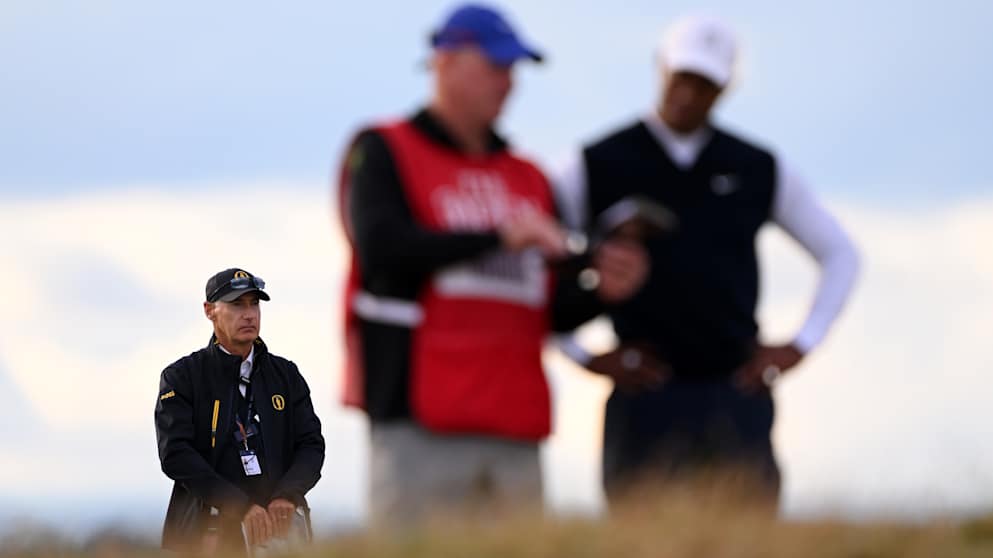
Respected by colleagues and players alike spanning several generations, the Scot is retiring at the end of December following almost 40 years of service with the European Tour group.
Since joining the European Tour, now known as the DP World Tour, in 1986, Stewart has overseen close to 600 tournaments and refereed at the Major Championships and multiple Ryder Cups.
Across that time, he has served as a referee and then as a tournament director – most notably at the Dubai Desert Classic and Scottish Open – and was most recently the Director of Qualifying School.
Such was his standing not only at the Tour but among other organisations, Stewart was given the honour of being the walking official for Woods’ group in his final appearance working at The Open Championship at St Andrews in 2022.
Modest about his achievements, he departs as the longest-serving member of the Tour staff.
How did you first get involved in golf officiating?
I started with the PGA of Scotland in 1984. I got a job there working under Sandy Jones, who went on to become the chief executive of the PGA for many, many years. I had that role for two years. I was then lucky enough to secure a position with the European Tour. It was an opportunity that arose and I thought I might as well have a go, and it was really just my good fortune that Ken Schofield [the then European Tour’s Executive Director] decided to offer me a job in our Tour Operations department as a referee.
What did it mean to get the role at the Tour?
I've played golf for most of my life. I've never been a professional or played at an elite level but I just had a passion for the game. If you've got any sporting inclination at all, the thought of being involved in sport is quite appealing. I didn't aspire to get into golf. It was just a case of there's an opportunity, let's try that and then my role with the Scottish PGA turned into a role with the European Tour. At that time, I think I was about the 20th employee of the company.
Who did you work alongside when you joined the Tour?
First of all, in the early days, the three key people I was working with and under were Tony Gray, John Paramor and Andy McFee. All were fantastic tournament directors, all very highly thought of in the world of golf. I was lucky enough to learn a lot from them. I was also mentored as a referee by the late, great Keith Williams
What are your memories of your first event?
My first event was the Spanish Open at La Moraleja in May 1986. Andy McFee was the tournament director, and I went out there as a referee. Like anybody who suddenly finds himself heading off to a big tournament in another country, it was a whole new experience. Going out to Spain and working with the Spanish Golf Federation and the tournament promoter, Amen Corner was a very steep learning curve for someone more used to running one day pro-ams in Scotland.
That week, I think it was on Tuesday, I can remember exactly where I first met Seve Ballesteros under the steps of the La Moraleja club house, having been introduced by Andy.
How did your role at Qualifying School first come about?
Well, the end of that season (1986) was my first encounter with the Qualifying School, which was played at La Manga at the time. I can remember being down in Spain working on the event. It was run by Andy McFee, the then Qualifying School director.
How did your role come to evolve at the Tour?
Becoming a tournament director was just something you gradually moved into as you gained experience and opportunities arose. So, I started to do a few events as a tournament director, while also refereeing at the same time and that just evolved over a few years to the point, as we took on more staff, where I pretty much became a full-time tournament director. It was also around the early 1990s that we as a group of tour referees started to get invited by other organisations to officiate at the Major Championships. First of all, at The Open and then subsequently Augusta, U.S. Open and the US PGA Championship.
I went to countless Open Championships. I think it was about 27 I've worked at with my final one being the 150th at St Andrews in 2023
A key part of your work are the dealings with some of the world’s best-known players. What was the first such encounter that sticks with you?
Meeting Seve for the first time was pretty memorable. At the time he was the great big superstar of European golf. I think everybody was a bit in awe of him as I probably was at La Moraleja. That was my first meeting and as I got to know him over the years he was always really nice to me.
He had this incredible way of using the rules to his advantage. He could be very persuasive and could often talk referees into seeing things from his perspective. You’d say, ‘oh well, he's got a point there and maybe he should get a drop after all’. I think we all succumbed to Seve’s powers of persuasion at some point.
Any standout encounters with Seve?
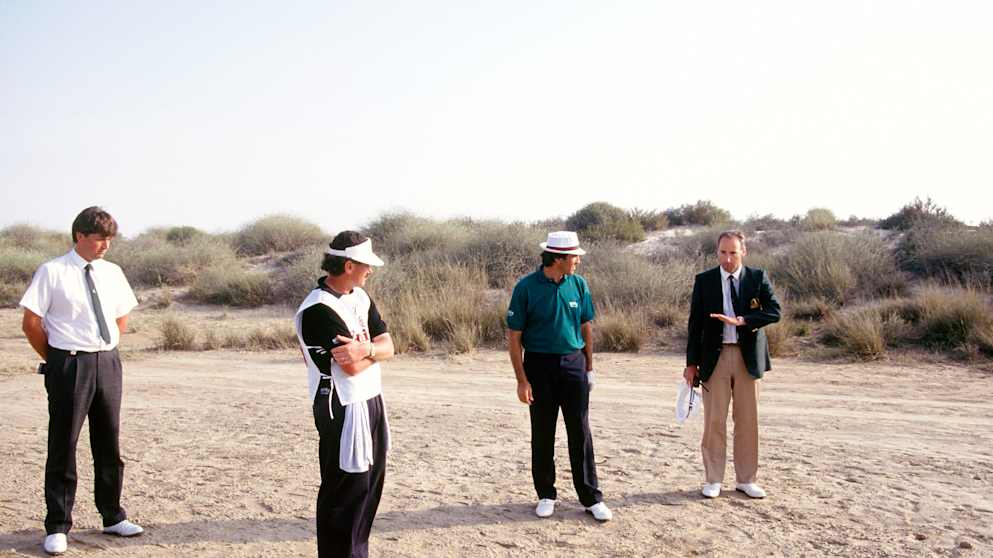
While I was getting quietly prepared for the presentation in Dubai in 1993, my colleague was giving Seve a ruling on the last hole. Anyway, Seve decides he doesn’t like the answer, so the referee said ‘OK, I'll give you a second opinion’.
Well, I'm currently getting ready for the prize presentation, getting my notes ready, what I'm going to say, who's going to be where, etcetera, etcetera. Then I’m suddenly called out to go to give this second opinion and my heartrate goes into overdrive.
And Seve tried everything under the sun to convince me that he should get relief from a ball that was embedded in sand in one of the sandy waste areas left of the 18th.
Everything he requested, I declined. As the sand was wet, he asked about casual water. No, Seve, you don't get that. He asked about unusual crowd damage. No, you don't get that here. And then he said, well, surely it just must be ground under repair. No, you don't get that either. In the end, he had to play the ball as it lay, and he just lost out after realistically needing an eagle to stand a chance of winning.
At the presentation afterwards, he wasn't angry or anything. He just came over and said, ‘by the way, Mike, I think you were wrong there. I should have had a free drop."
Is it a source of great pride for you that you have worked with so many of the game’s greats?
I was lucky to come across golf’s ‘big three’ of Jack Nicklaus, Gary Player and Arnold Palmer at the tail end of their careers. I did the first two or three Senior Opens at Turnberry, helping to get that event off the ground and Arnold and Gary played in them. Indeed, Gary won the second edition in 1988. I then met Jack for the first time playing in the Austria Open at Gut Altentann in 1990 on a course he designed. It was great to be involved with that generation, some of whom are true legends of the game.
I was fortunate to witness an incredible era for European golf which began with the likes of Sandy Lyle, Nick Faldo, Seve, Bernhard Langer, Ian Woosnam, José María Olazábal. To be around them and work with them was just absolutely brilliant. It's probably even more amazing now to look back on this golden generation of European golfers because at the time it just seemed normal.
Which event are you most proud of?
Well, I think it's 35 countries I've worked in for the Tour. The one tournament that stands out obviously is the Dubai Desert Classic for various reasons. It's worth knowing that I was the very first person from the European Tour ever to go to Dubai in 1988.
Apart from one year in 1991 when the event was cancelled due to the Gulf War, I was involved in every single edition. It was after 34 editions that I decided to step down, and it was the perfect place for me to end my career as a tournament director on the Tour because I've been so closely linked to that event for so long.
The event has continued to evolve from day one. It was always called the ‘jewel in the crown’ of our early season on Tour from the early days because it was a great place to go to. Most of the top players have been there at some stage. Simply, a terrific event played at a great time of the year on a great golf course at an iconic venue.
Part of what makes Qualifying School great is the platform it gives to players – how do you reflect on that as an event over the years?
It was originally the only way of really getting onto the Tour because there weren't many other options. Any player who wanted to establish themselves back in the 70s and 80s had to go to Qualifying School.
The emergence of the Challenge Tour now HotelPlanner Tour in 1989 changed that, because performance over the course of a season became more important than performance over one week at Q-School.
There are now even more avenues to get onto the Tour. We never had co-sanctioned events back in the day but those, such as with the Sunshine Tour, have become quite significant. Those pathways give a huge opportunity for the southern hemisphere players to play their way onto our Tour without coming to Q-School or playing on the HotelPlanner Tour.
I have a picture somewhere and it appears on one of the yearbooks of the Q-School graduates from 1989 and if you look back at that picture, there's so many well-known faces who went on to have great careers in golf in some respect. You had Vijay Singh, Jesper Parnevik, Paul Broadhurst, Jean Van De Velde, Carlos Franco but then others like Andy Stubbs who went on to run our Legends Tour for a while.
There were plenty of people like that that were playing Q-School at the time and made a name for themselves in other ways, like Pete Cowen, the world-renowned coach. In my first year [as Q-School director] Nick Dougherty finished third at Final Stage at San Roque. I think it was his first Q-School having turned professional that year. He started to have a great playing career but then things went in a different direction for him, and he’s become an outstanding broadcaster.
Not everything is plain sailing as a tournament director, so what’s been the biggest logistical challenge?
Well, it was coincidentally at my final Desert Classic in 2023. It was an absolute nightmare because the weather was horrific during the week. Heavy overnight rain on Wednesday night and Thursday meant severe flooding and we lost over eight hours of play on the first two days and ended up running into Monday to complete the golf tournament.
It was so bad that the golf club was closed on Thursday morning and no-one was allowed in and it was virtually impossible to get there anyway. When play eventually started it was ‘behind closed doors’ due to spectator safety concerns.
In these extreme situations you are constantly working on a strategy and contingency plans to deal with all possible eventualities. It's not just about having the golf course playable, but can players actually get to the golf course to play? Are the structures safe? Can we let people into the structures? Do we reduce the event to 54 holes? Those are all the sort of conversations we had.
The other one, which was equally as bad in many ways, was at the Scottish Open at Castle Stuart in 2011 where on the Saturday morning we arrived at the course to find a landslide across the first fairway and a further smaller one on the 12th hole.
We’ve not really touched upon the Ryder Cup. What is a standout memory for you?
Well, my first one was in 1989 at The Belfry refereeing there. My recollection is that he atmosphere between the players was pretty intense. I have to say there is nothing else in golf like it. Having worked pretty much all the major golf events around the world, it’s above and beyond anything I've ever been involved with. It's just an incredible experience to be involved in something like the Ryder Cup, especially being inside the ropes with the matches. That year, Faldo made a hole-in-one at the 14th, and I was the referee with him in that match and there’s now a plaque at the side of the tee. When I last saw him at The Belfry, I said "there’s something missing off that plaque. It doesn't tell you who the referee of the group was!"
And lastly, how do you reflect on your time working for the Tour?
I'm incredibly proud of it. As I said earlier, there were 20 of us when I started. Now, we are well over 300. So, it gives you an indication of the growth of the whole organisation which is quite incredible and I feel privileged to have been involved as part of Ken Schofield’s team, building the foundations for what we have today. Nowadays, everything that we do in the business is so much more professional and that's been great to see. I think I'm leaving it in a much better place than when I started. But maybe it’s not as much fun. We had a lot of fun in those good old days!
Mike Stewart was speaking to the DP World Tour's Digital Editor Mathieu Wood
Bryan Angus (edit)

No comments:
Post a Comment